


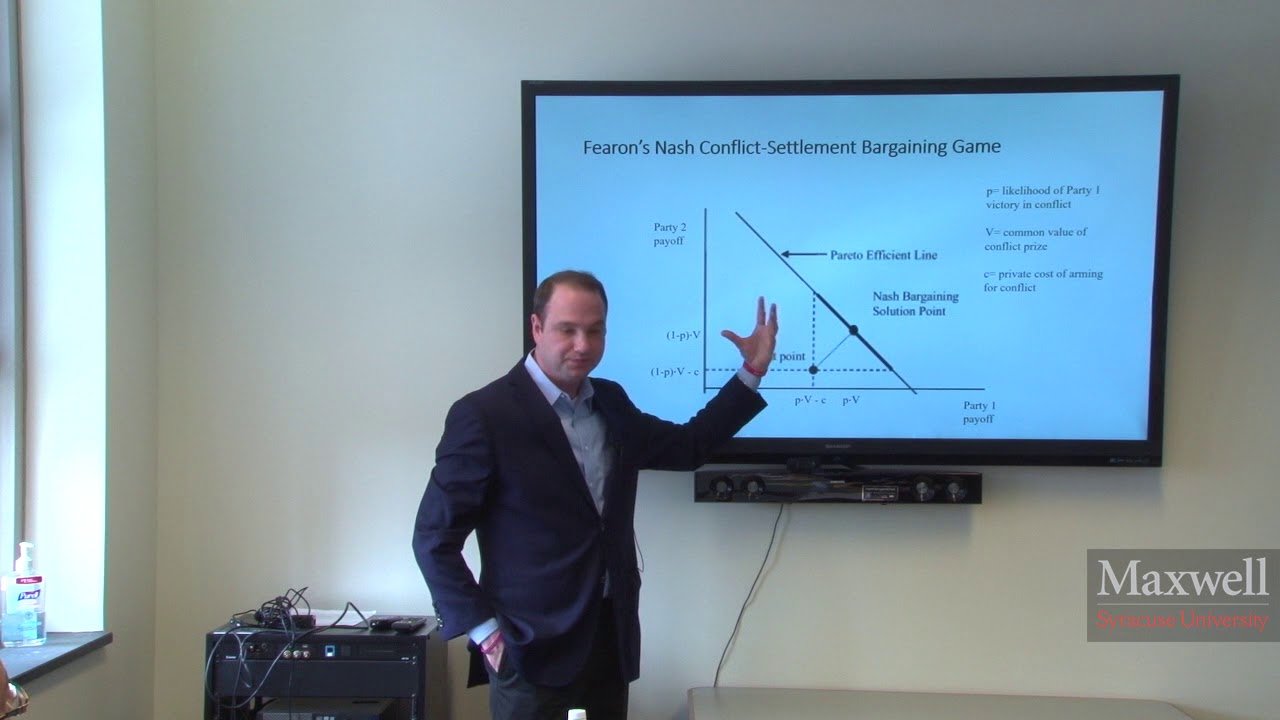
 March 21, 2018. PARCC Conversations in Conflict Studies Series. Guest Speaker: Shane Sanders. Associate Professor, Sports Economics & Analytics, Falk College of Sport & Human Dynamics, Syracuse University. Fearon (1995) demonstrates within a continuous choice, contest model that conflict is inefficient (payoff-decreasing) when a settlement option exists. Why, then, is conflict observed in various forms? We demonstrate Fearon’s puzzle within a discrete choice, game-theoretic model of conflict (i.e., within a simplified or stylized game setting that serves to mimic Fearon’s payoff setting). We call the game Fight or Settle. Within the game, settlement division (e.g., over a conflicted territory) raises expected payoffs as compared to conflict division. Despite being payoff-dominated, however, conflict division represents a unique Nash equilibrium within the game Fight or Settle. As such, we can characterize Fight or Settle as a Prisoner’s Dilemma or Tragedy of the Commons type game, whereby an inefficient outcome occurs as a result of players independently (non-cooperatively) choosing a strategy.
Shane Sanders. “War’s Inefficiency Puzzle: An Examination Using Non-Cooperative Game Theory” - YouTube | |
| 3 Likes | 3 Dislikes |
| 160 views views | 2,402 followers |
| News & Politics | Upload TimePublished on 3 Apr 2018 |
